How To Install Ghost on Ubuntu 22.04 - A Step-by-Step Guide to Setting Up Your New Blog
While WordPress has reigned king for quite a while in terms of content management systems, Ghost is catching on quickly for good reason. Here's why, and how to install it.
Managing a website or blog becomes significantly easier with a content management system (CMS).
Who wants to handle every page individually? Not me.
While WordPress dominates a large portion of the internet due to its ease of use, it does have its drawbacks, such as the requirement of PHP and being resource intensive.
That's why many valid competitors to WordPress have popped up over the last few years...
Such as Ghost, a modern CMS that skips PHP (opting for Node.js instead), offering a sleek, fast, and user-friendly alternative for bloggers and web administrators.
Ghost represents a new era in CMS design, focusing on simplicity, speed, and an intuitive user experience.
It's not quite as easy to install as something like WordPress, though...
That's why the team over here at xTom made this blog post!
In it, we'll be showing you exactly how to install Ghost step-by-step, with the recommended Linux distribution, Ubuntu.
Let's dive in.
Step 1: Create a new user
First, we need a user other than root to run Ghost under:
adduser <user>
Avoid using the username ghost as it conflicts with Ghost-CLI.
Then add the user to the superuser group:
usermod-aGsudo<user>
Then log in as the new user:
su - <user>
Step 2: Update packages
Next, update your package lists and installed packages:
sudoapt-get update
sudoapt-get upgrade
Step 3: Install Nginx
Now we'll need to install our web server:
sudoapt-getinstall nginx
Then configure UFW:
sudo ufw allow 'Nginx Full'`
Step 4: Install MySQL
Next up, we need to install MySQL:
sudoapt-getinstall mysql-server
It should be noted that Ghost is not officially compatible with MariaDB.
Step 5: Install Node.js
Ghost uses Node.js instead of PHP, so we'll also need to install that (use a supported version, e.g., Node 18):
Now we can install Ghost-CLI, the official Ghost management tool:
sudonpminstall ghost-cli@latest -g
Step 7: Install Ghost
Next we'll need to create a new directory to install Ghost in:
sudomkdir-p /var/www/sitename
sudochown<user>:<user> /var/www/sitename
sudochmod775 /var/www/sitename cd /var/www/sitename
Then finally the fun part!
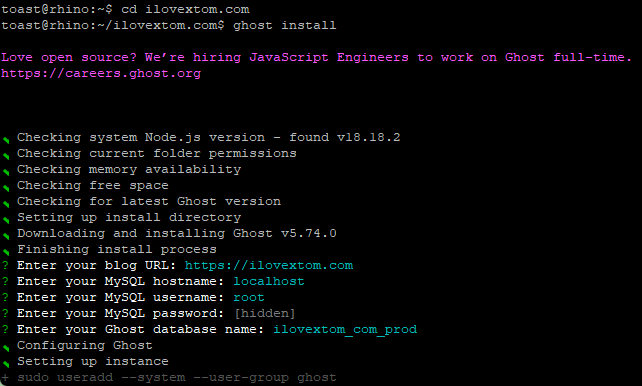
Run ghost install and follow the CLI prompts to configure your site, including setting up Nginx, SSL, and systemd.
For MySQL, you'll use your default root user and root password while installing.
I suggest also creating a separate MySQL user for Ghost while installing with Ghost-CLI.
Also, if you use an IP instead of a domain, you will receive an error here.
Congrats on the new Ghost blog!
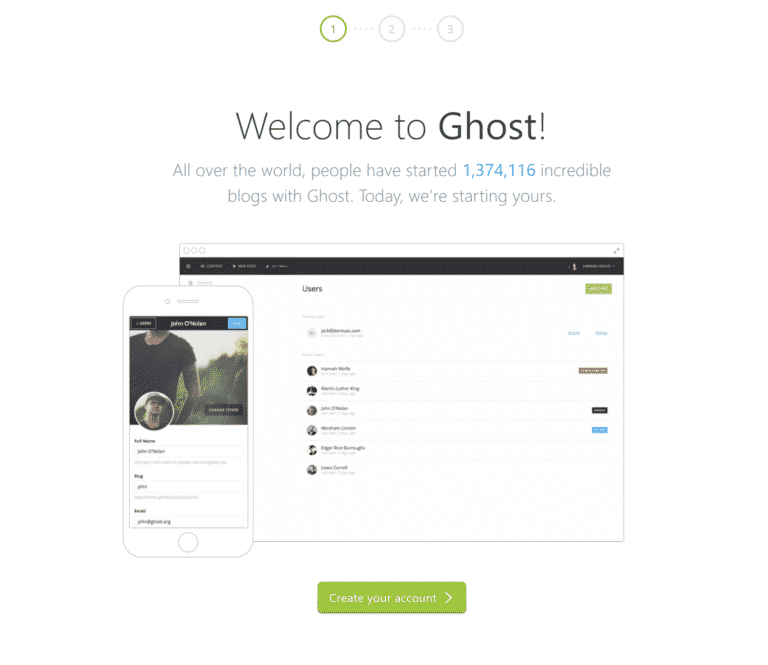
After completing the installation using Ghost-CLI, you can go to yourdomain.com/ghost and you'll be greeted with a page that looks like this:
Proceed with following the self-explanatory steps, and you now have a new Ghost blog!
By the way: to keep Ghost updated in the future, you can simply run ghost update via terminal.
For more information surrounding Ghost and its commands and possibilities, run ghost help.
Troubleshooting
If the installation fails, use ghost uninstall to remove it and try again. For interrupted installations, use ghost setup to restart the configuration process.
We also suggest that you install Ghost on a fresh server, with only Ghost running on that server.
All of that being said...
Looking for a good host to run your Ghost blog on?
Regardless if you're looking to make a small blog for cheap that may be more likely viewed by you than anyone else, or, you're looking to run a large enterprise that receives hundreds of thousands of views per month, we can handle the job.
For starters, check out our VPS line here which can easily accomplish the task of hosting a Ghost blog and starts at as little as €6.95 monthly.
Then if you're still not sure what you need, or you just want a hand in deciding what's the right infrastructure for your new Ghost blog, feel free to reach out to our sales team here.
Thanks for reading, and here's to modern and optimized blogging platforms!